

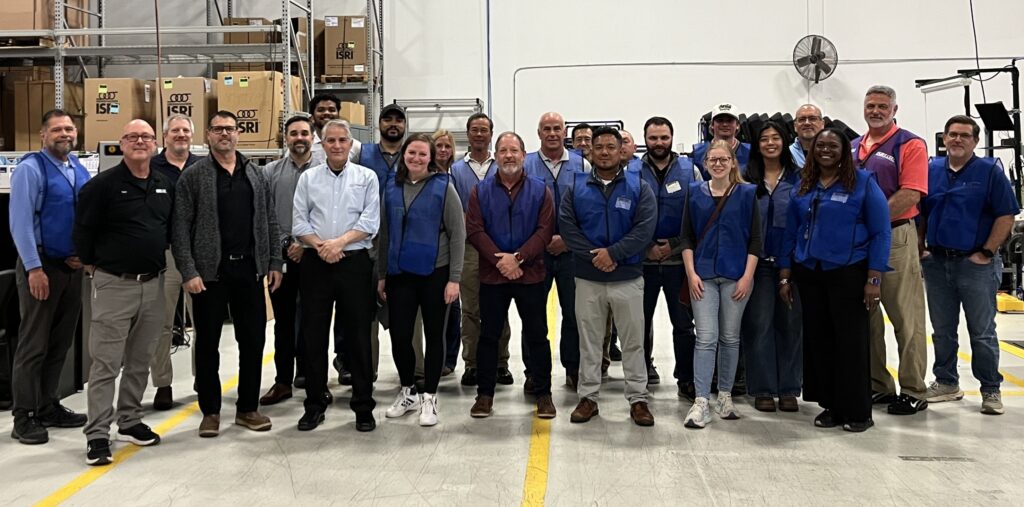
When you step onto the floor at Isringhausen USA in Ladson, it does not feel like the high-pressure environment you might expect from a just-in-sequence Tier 1 automotive supplier.
There is no sense of urgency in the traditional way – no rushing, no chaos. Instead, the operation runs with a calm, steady rhythm. Operators move with purpose, but not stress. That tone starts with leadership and carries throughout the plant.
During the visit, leaders were not tucked away in offices. They were on the floor – engaging with employees, shaking hands, and in one moment, even sharing a quick hug with a team member. Mike Mabbett, Plant Manager for the VS30 operation, shared that he prefers sitting on the floor rather than in an office.
It is a small detail, but it says a lot about the culture at Isringhausen.
Edson Pereira, Head of Operations shared, “Technology is very, very important to us, but people make the difference.”
A Just-in-Sequence Supplier Supporting Mercedes-Benz Production
That people-first culture Edson mentioned exists inside a highly disciplined system.
The Ladson facility operates as a just-in-sequence (JIS) supplier to Mercedes-Benz, located just across the street. Each seat built is tied to a specific vehicle – not just the model, but the exact unit and its place in the assembly sequence.
Once an order is received, the team has between fifteen and twenty-four hours to build, validate, and deliver the seat. With only a few hours of safety stock between the two operations, there is little room for error.
Execution here is not just important – it is critical. Any mishap could result in a costly line down situation for Mercedes-Benz.
Two Plants, Two Speeds
One of the more interesting aspects of the operation is what the team refers to as “two plants in one.”
On one side is the high-volume VS30 line, dedicated entirely to Mercedes-Benz. This is a tightly synchronized, sequence-driven environment.
On the other side is a high-mix, lower-volume operation producing commercial, military, and aftermarket seats for a wide range of customers.
The ability to run both models under one roof – one driven by precision sequencing, the other by flexibility – is a defining strength of the site.
Built for Flow, Moving Toward Ownership
While the long-term vision is for operators to ultimately “own” the full seat build, what stands out today is how well the current line is designed for flow and balance.
The high-volume VS30 line is a true sequential build – carefully structured so each station is aligned to takt, with work evenly distributed and minimal disruption between steps. It is clear that a great deal of thought has gone into creating a line that moves smoothly and predictably.
At the same time, operators are being cross-trained across adjacent stations – “one up, one down” – which adds flexibility and helps maintain that flow when variability occurs.
Over time, that foundation supports the broader vision: expanding skills to the point where an operator can build an entire seat, a model already in place at their Germany facility.
It is a thoughtful progression – from a well-balanced line today to full product ownership in the future – without sacrificing flow along the way.
Continuous Improvement That Moves Quickly
That ownership mindset shows up clearly in how improvements are made. At Isringhausen, much of that work is driven through CIPI (Continuous Improvement Program Isringhausen) led by Supplier Quality Engineer, Krushang Patel.
CIPI is designed to engage cross-functional teams in solving real problems on the floor, with a focus on practical, often simple improvements that deliver meaningful impact.
One example shared during the tour involved material flow. A previous cart-based staging system could lead to up to 30 minutes spent searching for the right components. By shifting to a conveyor-based approach, that time was reduced to about five minutes.
In another case, the team rethought how defective seats were handled. Instead of allowing them to cycle through a full rework loop, seats are now pulled off the line, corrected immediately, and reintroduced – protecting both flow and productivity. With each seat taking roughly two minutes to build, these kinds of improvements add up quickly.
What stands out, however, is not just the results – it is the approach.
These are not large, top-down initiatives. They are practical, employee-driven improvements, supported by a structured program that reinforces a culture of continuous improvement across the plant.
Technology That Supports the Process
Behind the scenes, a Manufacturing Execution System – Nemetris – plays a critical role in keeping the operation aligned.
Designed for just-in-sequence environments, the system bridges the gap between the shop floor and enterprise systems, helping ensure that every seat is built, validated, and delivered in the exact order required.
Nemetris manages real-time production tracking, takt-based scheduling, and digital work instructions, while also incorporating built-in poka-yoke controls. It captures detailed traceability throughout the process, linking each seat to its full production history – an essential capability in a high-stakes automotive environment.
The system also provides real-time dashboards across the floor, giving operators and leaders immediate visibility into production status, sequencing, and performance. Visual indicators make it easy to quickly identify issues and respond before they impact flow.
Combined with end-of-line testing and a 100% inspection process, the technology supports a system where quality is built into every step—not just inspected at the end.
Designing for the Driver
One of the most memorable parts of the visit came away from the production line.
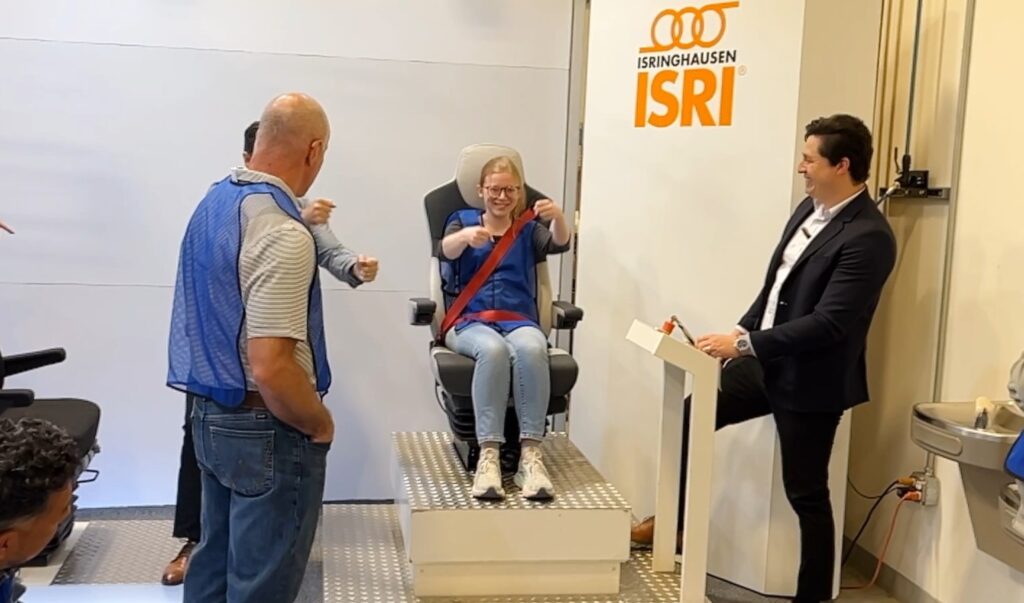
In a showroom area, the team demonstrated a seat simulation designed to replicate real driving conditions. What started as a smooth ride quickly transitioned into increasing levels of vibration, jolts, and sustained motion.
It was a simple demonstration – but a powerful one.
Guilherme Ribeiro, who is the Sales Manager, said: “You don’t realize what drivers feel for hours at a time.”
It reframed the product entirely.
These seats are not just components – they are part of the driver’s daily experience, designed to reduce fatigue, improve comfort, and support long-term health.
A Culture That Drives Results
Over the past several years, the Ladson facility has undergone a significant cultural transformation.
Turnover has dropped dramatically – from 12% in 2022 to just 1.8% in 2025.
When asked what had driven higher turnover in the past, Mike Mabbett shared that the reason employees gave was simple: “Management.”
That level of ownership has shaped the changes that followed – not just in systems, but in leadership approach, visibility on the floor, and creating clear pathways for employees to grow and contribute.
A major driver has been a pay-for-performance system tied to skill development. Employees increase their earnings by learning additional stations, expanding their capabilities, and contributing to performance across the line.
Additional incentives tied to quality, attendance, and efficiency reinforce that ownership.
The result is a workforce that sees opportunity – not just a job.
Final Thought
In a just-in-sequence manufacturing environment, where every product must arrive at the right place, at the right time, and in the right order, it is easy to assume that success depends entirely on systems.
At Isringhausen, the systems are strong.
But it is the culture – visible on the floor, embedded in the process, and driven by the people –that makes the difference.
Frequently Asked Questions (FAQ)
What is just-in-sequence (JIS) manufacturing?
Just-in-sequence (JIS) manufacturing is a production method where parts are delivered to the customer in the exact order they are needed on the assembly line. This ensures efficient production flow and minimizes inventory.
What does the Isringhausen Ladson plant produce?
The Isringhausen USA plant manufactures automotive seating systems, including high-volume seat production for Mercedes-Benz, as well as commercial, military, and aftermarket seating products for Prevost, Komatsu, Mack, AM General, Liebherr, Volvo, New Flyer .
How does Isringhausen support Mercedes-Benz production?
Isringhausen operates as a just-in-sequence supplier, building seats in the exact order required and delivering them within hours of a call-off signal. This allows seamless integration with Mercedes-Benz’s assembly line.
What is a Manufacturing Execution System (MES)?
A Manufacturing Execution System (MES) is software that monitors and controls production on the shop floor. At Isringhausen, the Nemetris MES system tracks production in real time, provides work instructions, and ensures quality through traceability and error-proofing.
What is CIPI at Isringhausen?
CIPI (Continuous Improvement Program Isringhausen) is a structured initiative that engages employees in solving problems and improving processes. Led by Supplier Quality Engineer Krushang Patel, it focuses on practical, employee-driven improvements across safety, quality, and efficiency.
How has Isringhausen improved employee retention?
The Ladson plant reduced turnover significantly by implementing a pay-for-performance system, expanding cross-training opportunities, and fostering a culture where employees have clear paths for growth and ownership of their work.
Why is seat design important in commercial vehicles?
Seats play a critical role in driver comfort, safety, and fatigue reduction. Isringhausen designs seating systems with features like suspension, lumbar support, and climate control to improve the driver’s experience over long periods of use.
About Isringhausen
Isringhausen (ISRI) is a global manufacturer of seating systems for automotive, commercial vehicle, and industrial applications. The company is part of the Aunde Group, a family-owned organization with more than 100 years of history and operations spanning over 28 countries.
Isringhausen specializes in the design and production of high-performance seating solutions for OEM and aftermarket customers, with a focus on ergonomics, safety, and durability. Its Ladson, South Carolina facility – established in 2017 – supports both just-in-sequence automotive production for Mercedes-Benz as well as a diverse mix of commercial, military, and industrial seating programs.
About OpExChange
The OpExChange, sponsored by the South Carolina Manufacturing Extension Partnership, is a peer-to-peer network of manufacturers and distributors in South Carolina known for generating success for members through benchmarking and best practice sharing. Member companies host events and share practical examples of industrial automation, lean manufacturing improvements, and leadership development. It is an invaluable resource to South Carolina companies that provide access to others who are on similar improvement journeys. If your company is interested in participating in this collaborative effort to improve both the competitiveness of your operation and South Carolina, contact Mike Demos (MDemos@scmep.org). More information and upcoming plant visits are available on the OpExChange website www.OpExChange.com.