

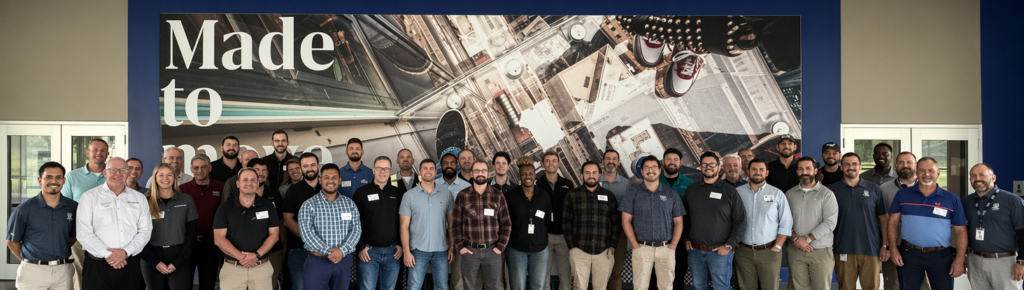
Otis Elevator welcomed OpExChange members to its manufacturing facility in Florence, South Carolina on June 16 for a plant tour focused on smart manufacturing, automation, and digital transformation. Thirty-three manufacturing professionals representing organizations from across South Carolina and North Carolina participated in the event, creating one of the most engaged and interactive discussions of the year.
Otis has been an OpExChange member since 2020 and currently participates at the Bronze membership level. This was the second time the company has opened its doors to the OpExChange community. While the first visit focused heavily on robotics and automation, this year’s event highlighted how those investments have evolved into a broader smart manufacturing strategy that connects equipment, material flow, warehousing, data analytics, and emerging artificial intelligence technologies.
The day began with presentations from several members of the Otis leadership, engineering, operations, and support teams. Jolly Ehiabhi, Manager of Smart Manufacturing Process & Systems, served as the master of ceremonies and guided attendees through the company’s ongoing transformation journey.
From Manufacturing Plant to Smart Factory
Otis began production in Florence in 2012 after consolidating multiple North American operations into a single facility. Today, the site manufactures elevator systems for customers across the United States and Canada and employs approximately 475 people. The operation is particularly challenging because it is a high-mix, low-volume environment where nearly every elevator configuration is unique.
Unlike manufacturers that produce the same product repeatedly, Otis must manage thousands of product variations. Different building heights, local building codes, customer specifications, and elevator configurations create significant complexity in both manufacturing and material flow.
To address these challenges, Otis has been executing a multi-year transformation plan centered around automation, digital connectivity, and operational excellence.
“We are continuously improving our products and our processes,” Ehiabhi explained. “As technology continues to advance, we want to be key players in that evolution.”
Factory Information Center Supports Tiered Communication
The first stop on the tour was the Factory Information Center, a visual communication hub that serves as the focal point for Otis’ tiered management process.
Facility Manager Annie Johnson explained that the objective of the center is to provide employees with immediate visibility into the health of the business. As Johnson shared, “Our goal here was to make sure that everybody that walks into our factory knows what our business is doing. You should be able to know immediately if there’s any safety incidents, if we’re having any quality issues.”
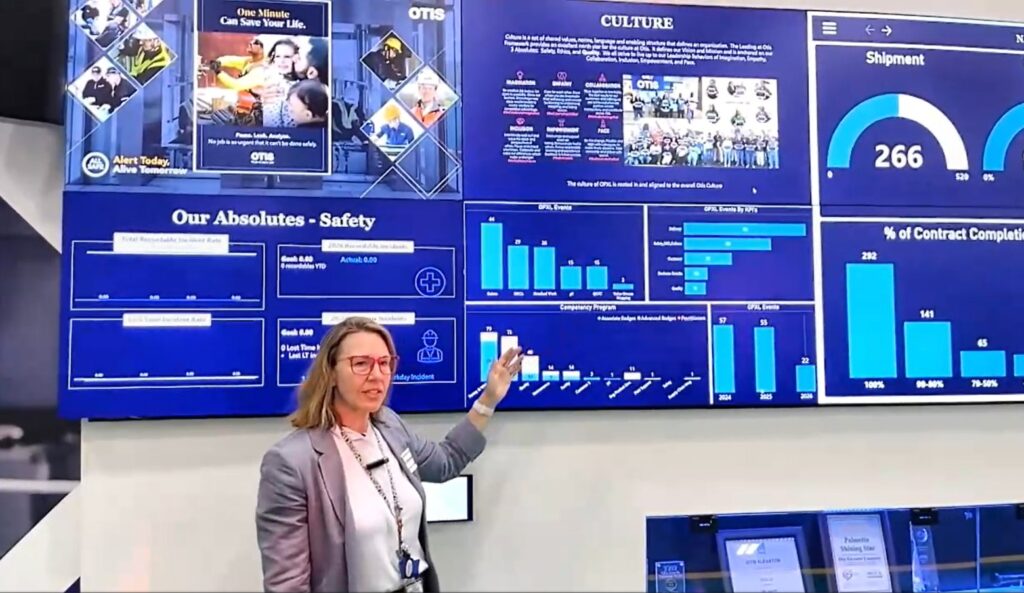
The communication center supports a structured four-tier meeting process. Tier 1 meetings occur at the shop floor level, Tier 2 at the supervisory level, Tier 3 at the management level, and Tier 4 with senior leadership. The boards display key metrics related to safety, quality, production performance, supplier performance, delivery, and employee communications, ensuring that critical information is visible and aligned throughout the organization.
Visitors noted that the boards focus on the metrics that matter most rather than attempting to display every KPI. The result is a visual management system that helps employees quickly understand current performance, identify emerging issues, and align improvement efforts across the facility.
The Factory Information Center serves as more than a display board. It is the communication hub that connects Otis’ tiered management process, daily accountability, and continuous improvement efforts, helping ensure that teams throughout the facility are rowing in the same direction.
Automation Continues to Expand
A major focus of the visit was Otis’ continued investment in automation.
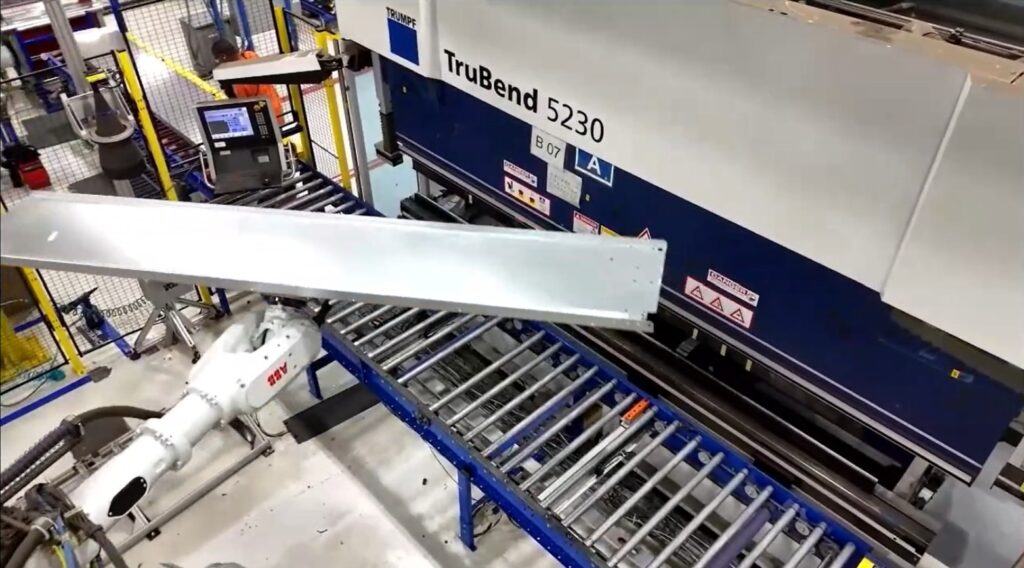
Visitors toured the company’s Trumpf Laser Combo cell, a highly automated manufacturing system that combines punching, laser cutting, automated storage and retrieval, robotic material handling, and automated palletizing. Material is automatically retrieved from storage, processed, and transferred to downstream operations with minimal human intervention.
The system represents a significant evolution from the manual punch press operations that existed only a few years ago. In addition to reducing labor content, the automated process improves quality, eliminates ergonomic risks, and supports lights-out manufacturing between shifts.
Attendees also visited the Structural Frame Cell, where automation has been deployed to improve safety and productivity while reducing variation in critical elevator components.
Throughout the facility, visitors observed how automation investments are being strategically applied to address workforce challenges, improve safety, and create more consistent manufacturing processes.
AMRs Transform Material Flow
One of the most anticipated stops of the tour focused on Otis’ deployment of Autonomous Mobile Robots (AMRs).
Unlike traditional Automated Guided Vehicles (AGVs), which follow fixed routes and stop when obstacles block their path, the new OTTO AMRs dynamically navigate throughout the facility. Similar to GPS navigation systems, they determine the most efficient route to their destination and can reroute around obstacles as conditions change.
The AMRs interface with specially designed modular carts that use 80/20 aluminum extrusions rather than traditional welded steel construction. This allows Otis to quickly modify cart designs as production requirements change without significant capital investment.
The long-term vision extends well beyond simple material transportation. Future phases include delivering electronic kits from Vertical Lift Modules directly to production lines and eventually transporting finished goods automatically to the distribution center.
Like many companies implementing advanced technologies, Otis encountered unexpected challenges during deployment. The team discussed network availability issues that required additional wireless access points and adjustments to support reliable robot communication throughout the facility.
The discussion generated significant interest among attendees and led to an engaging exchange on material handling strategies, AMR deployment, and emerging technologies.
Vertical Lift Modules Create Warehouse Capacity
Another highlight of the tour was the warehouse transformation initiative.
Faced with the challenge of absorbing additional inventory without expanding the physical footprint of the building, Otis redesigned its warehouse operations around vertical storage and automation.
The implementation of Vertical Lift Modules (VLMs) dramatically reduced the floor space required for electronic component storage while simultaneously improving picking efficiency and inventory accuracy.
The VLM system integrates directly with the company’s ERP system and guides operators through the picking process using laser indicators and visual prompts. The result has been reduced walking time, improved accuracy, and significant labor savings.
Warehouse leaders explained that the broader strategy is to automate material movement from storage through production while improving inventory visibility and supporting future growth.
Real-Time Monitoring Creates Immediate Visibility
A recurring theme throughout the day was data visibility.
Otis has connected approximately 100 assets throughout the facility to a real-time monitoring system that captures production data directly from equipment and conveyors.
Using Kepware and internally developed applications, the system tracks throughput, first-pass yield, production performance, and other key metrics without requiring manual data collection.
Large visual displays located throughout the factory provide operators and supervisors with immediate feedback on performance. The system automatically captures production activity and identifies deviations from expected performance, helping teams quickly address issues before they become larger problems.
The initiative represents a significant step in Otis’ Industry 4.0 journey and lays the foundation for future predictive analytics and AI applications.
AI Sparks One of the Day’s Most Interesting Discussions
While the technologies demonstrated during the tour were impressive, one of the most engaging discussions occurred during the Plus/Delta collaboration session that followed.
The conversation centered around the growing use of artificial intelligence and advanced camera systems in manufacturing.
Otis currently utilizes a Verkada camera system with more than 120 cameras throughout the facility. The system is being used for security, safety monitoring, occupancy tracking, and operational awareness. AI-driven alerts can identify situations such as employees entering designated areas without required PPE and provide immediate notifications to plant personnel.
The discussion quickly expanded as attendees shared experiences from their own facilities.
Atlas Copco discussed ongoing evaluations of AI-powered video analysis platforms capable of performing time studies, line balancing, ergonomics assessments, and even automatically generating work instructions from recorded video. One of the platforms discussed was Retrocausal, which uses artificial intelligence to analyze operator motions and identify opportunities for process improvement.
The conversation highlighted how manufacturers are beginning to move beyond traditional uses of cameras for security and are exploring how AI can convert video data into operational insights.
For many participants, this discussion represented one of the most valuable peer-to-peer learning opportunities of the day.
A Culture of Continuous Improvement
Perhaps the most significant takeaway from the visit was not a specific technology, but rather the culture that supports continuous improvement at Otis.
Throughout the facility, visitors observed evidence of a structured transformation plan, visual management systems, employee engagement, and a willingness to challenge traditional processes.
The Plus/Delta session generated a lively exchange of ideas and recommendations covering topics such as warehouse design, material flow, ergonomics, visual management, VLM utilization, supplier performance metrics, and AMR implementation strategies.
The willingness of both the Otis team and visiting manufacturers to openly share challenges, lessons learned, and improvement opportunities exemplified the collaborative spirit that makes the OpExChange network valuable.
As Otis continues its smart manufacturing journey, the Florence facility provides a compelling example of how manufacturers can combine automation, digital technology, data visibility, and continuous improvement to build the factory of the future.
The OpExChange thanks Jolly Ehiabhi and the entire Otis team for opening their facility and sharing their experiences with fellow manufacturers.
About Otis Elevator
Founded in 1853 by elevator safety pioneer Elisha Graves Otis, Otis is the world’s leading manufacturer, installer, and service provider of elevators, escalators, and moving walkways. The company moves approximately 2.5 billion people every day and maintains more than 2.5 million customer units worldwide, the largest service portfolio in the industry. With approximately 72,000 employees globally, Otis serves customers in some of the world’s most recognizable buildings, transportation hubs, and commercial facilities. The Florence, South Carolina facility manufactures elevator systems for customers throughout North America and serves as a showcase for the company’s ongoing investments in automation, smart manufacturing, digital connectivity, and operational excellence.
About OpExChange
The OpExChange, sponsored by the South Carolina Manufacturing Extension Partnership, is a peer-to-peer network of manufacturers and distributors in South Carolina known for generating success for members through benchmarking and best practice sharing. Member companies host events and share practical examples of industrial automation, lean manufacturing improvements, and leadership development. It is an invaluable resource to South Carolina companies that provide access to others who are on similar improvement journeys. If your company is interested in participating in this collaborative effort to improve both the competitiveness of your operation and South Carolina, contact Mike Demos (MDemos@scmep.org). More information and upcoming plant visits are available on the OpExChange website www.OpExChange.com.