

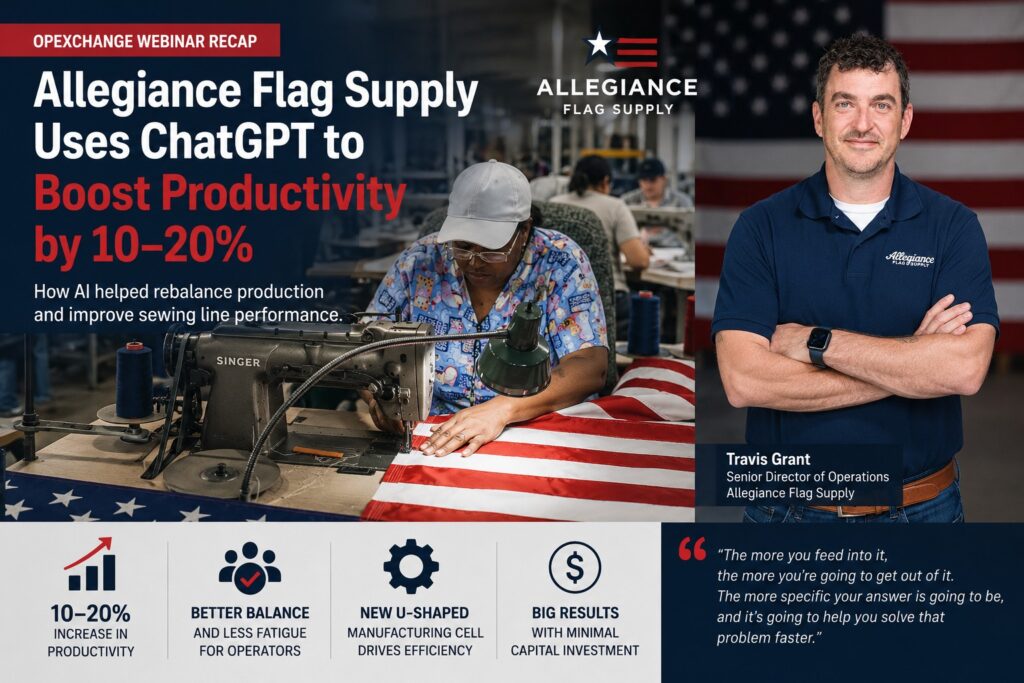
More than 70 manufacturing professionals joined OpExChange on June 24 for a highly interactive webinar featuring Travis Grant, Senior Director of Operations at Allegiance Flag Supply. The session offered a practical look at how one South Carolina manufacturer used ChatGPT to solve a real production challenge – and achieved measurable results in the process.
For many manufacturers, Generative AI remains surrounded by both excitement and uncertainty. Questions about where to start, how to use it effectively, and whether it can deliver meaningful operational improvements continue to dominate conversations across the industry.
Rather than discussing AI in theory, Travis shared a real-world example from Allegiance Flag Supply’s North Charleston operation.
Founded in 2018 with a mission to manufacture premium American-made flags, Allegiance has experienced remarkable growth in just a few short years. Today, the company operates from a 31,000-square-foot facility, ships more than 2,000 flags per day, and employs more than 100 people while supporting numerous suppliers throughout the American textile supply chain.
Like many manufacturers, Allegiance continually evaluates opportunities to improve productivity, reduce operator fatigue, and create a better work environment for employees. One area of focus was the company’s sewing operation, where workloads had become unevenly distributed across operators.
Using traditional time-study methods, the team understood where the bottlenecks and frustrations existed. Certain operators were performing significantly more movement and handling than others, resulting in unnecessary fatigue and inefficiencies. Initial attempts to rebalance the line through conventional approaches produced limited results.
Instead of continuing down the same path, the team decided to try something different.
Working with extensive operational data—including cycle times, process flows, changeover information, and production constraints—Allegiance began using ChatGPT as a problem-solving partner. Rather than asking broad questions, the team provided detailed information about its operation and challenged the AI to identify alternative ways to balance work across the line.
The recommendation that emerged was not what the team expected.
ChatGPT proposed reorganizing the production flow into a U-shaped manufacturing cell that would allow operators to perform non-sequential tasks while maintaining the required process sequence. The suggested layout redistributed workloads more evenly, reduced unnecessary movement, and created a more balanced production environment.
Rather than implementing the recommendation blindly, the team validated the concept through additional research, reviewed examples from other manufacturers, and piloted the idea on a single production line before expanding it further.
The results were impressive.
Within the first month, Allegiance experienced productivity improvements of approximately 10 to 20 percent while requiring very little capital investment. Just as importantly, operator feedback was overwhelmingly positive. Employees reported less fatigue, less unnecessary movement, and a workflow that simply made more sense.
One of the most interesting aspects of the project was that AI did not replace engineering judgment or operational expertise. Instead, it served as a catalyst for thinking differently. The technology challenged assumptions, proposed alternatives, and accelerated analysis, while the manufacturing team remained responsible for validating and implementing the solution.
Throughout the discussion, Travis emphasized several lessons learned. First, the quality of the output depends heavily on the quality of the input. Detailed data and well-constructed prompts produced dramatically better results than generic questions. Second, manufacturers should remain open-minded when evaluating AI-generated recommendations. Some of the most valuable ideas may be ones that were not initially being considered. Finally, AI should be viewed as a tool to support decision-making rather than replace it.
The conversation expanded beyond Allegiance’s sewing operation as attendees shared examples of how their own organizations are using Generative AI. Participants discussed applications ranging from supplier sourcing and RFQ generation to compliance documentation, HR knowledge bases, software development, and customer questionnaires. Several companies also shared experiences using enterprise AI environments that provide greater security and control over sensitive information.
The webinar served as another example of the OpExChange Ripple Effect in action. A manufacturer encountered a challenge, experimented with a new approach, achieved meaningful results, and then openly shared those lessons with peers across the region.
As manufacturers continue exploring the role of AI in their operations, the experience shared by Allegiance Flag Supply demonstrated that some of the most impactful applications may not require large investments or complex technology initiatives. Sometimes the biggest gains come from combining good operational data, a willingness to experiment, and the courage to ask a different question.
Key Takeaway
Allegiance Flag Supply achieved a sustained 10–20% productivity improvement by combining traditional industrial engineering practices with AI-assisted analysis, demonstrating how Generative AI can help manufacturers uncover opportunities that might otherwise remain hidden.
Event Resources
- Webinar Recording
- Presentation Deck, including prompt examples
- AI Deck from Plant Manager’s Exchange – Last Slide – How to do an AI pilot with Existing Data