

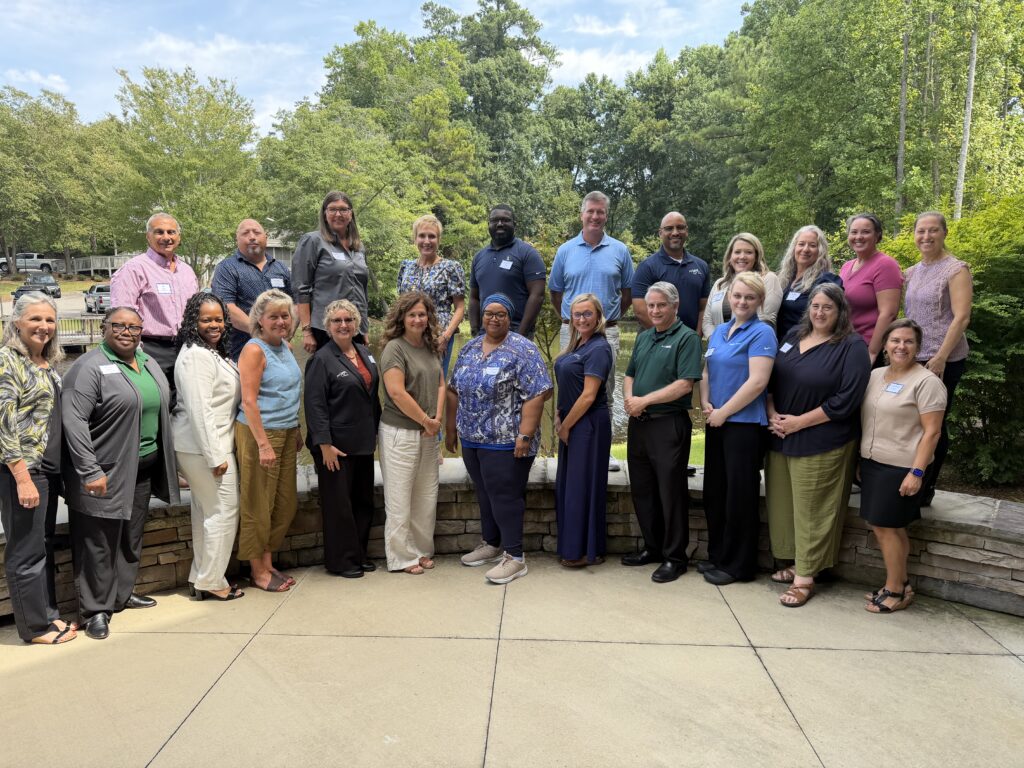
Twenty HR leaders representing manufacturers and organizations from across South Carolina came together for the OpExChange’s second HR Leader ExChange, a half-day peer-learning event focused on some of the most pressing people challenges facing manufacturers today.
Participants represented a particularly diverse cross-section of the state’s manufacturing community – small, medium, and large organizations from industries including automotive, metalworking, nuclear energy, construction equipment, textiles, industrial refrigeration, rail transportation, bearings, building materials, and more.
But despite the differences in their companies, a theme quickly became apparent: many of their HR challenges are remarkably similar.
The event was intentionally designed to capitalize on that common ground.
Participants Chose the Conversation
Rather than determining the agenda for them, OpExChange members were given a list of potential discussion topics in advance and asked to vote on the issues they most wanted to explore.
Those choices produced three facilitated discussions:
Process & Continuous Improvement
Lean HR: Where Is the Waste Hiding in Your HR Processes?
Workforce & Talent Strategy
Workforce Pipeline & Frontline Leadership
Teams & Leadership Dynamics
Leading Through Change: Why Do Employees Resist – and What Can Leaders Do Differently?
Three subject-matter experts were selected to facilitate the conversations.
Kirsten Gallagher, founder of The Kaizen Ninja, is a continuous improvement consultant and trainer who helps organizations apply Lean thinking to operational and administrative processes. She partners with SCMEP on training and improvement initiatives.
Dr. Rebecca Battle-Bryant, Director of South Carolina’s Office of Statewide Workforce Development within the Department of Employment and Workforce, brought extensive experience in HR, workforce development, education, consulting, and leadership training. Rebecca is the co-author of “The Workforce Development Playbook.”
Jim Fadell, founder of Carolina Training & Assessments, is an experienced leadership and organizational-development consultant who spent the first 25 years of his career in manufacturing before moving into leadership training and assessment. He also partners with SCMEP to help manufacturers strengthen leadership effectiveness, communication, culture, and employee engagement.
Participants were intentionally divided into three randomized groups and rotated among the facilitators. The format gave everyone an opportunity to interact with different peers throughout the morning.
The role of the facilitators was not to lecture. Instead, they introduced ideas, asked questions, challenged assumptions and, most importantly, encouraged the participants to learn from one another.
That distinction is fundamental to the OpExChange model: the expertise in the room does not reside only with the person standing at the front of it.
Lean Thinking Comes to HR
Kirsten challenged participants to look at HR processes the same way their organizations would examine a manufacturing process: Where is the waste?
Where are the unnecessary handoffs, delays, approvals and redundancies? Who actually owns each step? Are companies automating inefficient processes rather than fixing them first?
One subject dominated all three of her groups: onboarding.
Participants described everything from sophisticated HR systems to processes still dependent upon paper, spreadsheets, signatures, scanning and manual follow-up. Even highly automated systems presented challenges when different platforms did not communicate with one another.
A recurring recommendation was to map the entire onboarding process across departments and systems rather than viewing it solely as an HR responsibility. Kirsten recounted several experiences leading Kaizens to remove waste in onboarding.
A RACI or RASCI analysis can then clarify who is responsible, accountable, supporting, consulted and informed at each stage. HR may be accountable for ensuring the overall process works, for example, but IT may own computer access, Safety may own safety training, and the employee’s manager should own significant portions of job and departmental orientation.
Kirsten later summarized one of her biggest observations from the sessions:
“The best way to improve the experience for new employees and ultimately increase retention is by focusing on the employee’s experience and improving and streamlining their interactions. Start by mapping the entire onboarding process flow across departments, roles, and systems to eliminate excess paperwork, redundancies and align accountability throughout the process.”
The conversations also extended beyond onboarding to disconnected HR systems, paper-heavy disciplinary processes, HR metrics, compensation, global versus local processes, and the tendency for responsibilities belonging to other functions to eventually find their way back to HR.
The overarching Lean lesson was straightforward:
Before automating a process, understand it. Eliminate what does not add value. Clarify ownership. Standardize what remains. Then use technology where it actually improves the process.
Finding – and Keeping – the Next Generation
Rebecca’s sessions combined two topics that had tied in the participant voting: where manufacturers will find their future workforce and how frontline leadership affects whether those employees stay.
She framed workforce strategy around three interconnected “R’s” – Recruiting, Retention and Reputation.
Much of the recruiting conversation challenged manufacturers to reconsider how they describe jobs and identify talent.
One concept that resonated strongly with participants was the “skills flip.”
Instead of beginning a job posting with a long list of specific tasks and experience requirements – particularly tasks the company plans to teach anyway – employers can identify the underlying skills and capabilities required for success and make those more prominent in the posting, application and interview process.
The same principle applies to candidates. Young people may have developed valuable skills through retail jobs, athletics, school activities, military service or other experiences but may not know how to translate those experiences into the language employers use.
That means manufacturers may be overlooking capable people simply because the candidate has never held the exact job before.
The conversation naturally led to another major theme: internships and work-based learning.
Rebecca encouraged manufacturers to think of internships not as an expense but as an investment in their future workforce. Even companies that cannot immediately build a large formal program can start with one intern and build from there.
Participants discussed high-school and college internships, apprenticeships, technical-college partnerships, teacher externships, job shadowing, employee referrals and using younger employees as ambassadors to introduce the next generation to manufacturing careers.
Internships, however, need to be meaningful. Giving a future engineer a summer of making copies does little to create enthusiasm for a manufacturing career. Real projects, exposure to different functions, interaction with leaders and an opportunity to present results create a much different experience.
The conversation then turned from getting employees through the door to keeping them there. One of the most persistent challenges discussed was the frontline supervisor.
Manufacturers often promote their strongest technician, machinist, operator or other technical performer into supervision. Technical excellence, however, does not automatically create the communication, coaching, conflict-resolution and people-development skills required to lead a team.
Participants shared approaches including supervisor training, communication role-playing, mentoring and buddy programs, stay interviews, skip-level conversations, accountability meetings between HR and supervisors, and even structured supervisor apprenticeship programs.
The connection between the two halves of Battle-Bryant’s discussion became clear:
Today’s workforce pipeline can become tomorrow’s leadership pipeline – but only if companies intentionally develop and retain the people they bring in.
Leading Through Change
Jim’s groups began with organizational change but quickly expanded into culture, accountability, generational differences, communication and team effectiveness.
Participants were dealing with many forms of change – acquisitions, new leadership, new technology, retiring employees, younger workers entering manufacturing, changing expectations and shifting workplace norms.
A central lesson was that announcing a change is not the same as leading people through it. Successful change requires a clear vision, alignment around that vision and an environment in which people can execute.
One participant shared an idea she hopes to implement at her company – conducting a ‘pre-mortem’ before major changes rather than relying solely on a post-mortem afterward.
Before implementing a major change, bring together the people who post-mortem will be affected and imagine that the initiative has failed. Then ask:
What went wrong?
The exercise gives employees an opportunity to surface fears, obstacles, unintended consequences and operational realities before the organization encounters them. It also creates involvement and alignment among the people who will ultimately have to make the change work. Jim shared that,
“What I love about this pre-mortem idea is that it’s building alignment within the organization. That’s a beautiful technique to do that.”
Another discussion explored mutual or reverse mentoring. This is a concept that Lindsay Stevens from MAU Workforce solutions is actively pursuing.
Rather than assuming mentoring must always flow from the older or more experienced employee to the younger employee, pair people from different generations so both teach and learn. A younger employee may help a veteran employee understand emerging technology or changing expectations, while the experienced employee transfers technical knowledge, organizational understanding, relationships and career wisdom.
The objective is not simply knowledge transfer. It also creates relationships between generations that might otherwise misunderstand one another.
Another powerful leadership discussion centered on the meaning of kindness.
Being kind does not mean avoiding difficult conversations.
In fact, allowing an employee to continue failing without clearly explaining expectations may be less kind than addressing the issue directly. Participants discussed the importance of combining candor with respect – setting clear expectations, providing timely feedback, coaching employees and holding people accountable.
The Conversation Continued After the Rotations Ended
After the three groups completed their rotations, each facilitator shared observations from the morning, and every participant was asked one final question:
What will you take back and do differently at your site?
What was intended as a wrap-up became another highly interactive discussion.
Participants mentioned ideas they wanted to explore further – skills-based recruiting, supervisor apprenticeships, onboarding improvements, accountability meetings, mutual mentoring, communication training, internships, HR technology and several books and resources mentioned during the sessions.
For some participants, the most important takeaway was not a particular tool at all. It was the network.
Several people identified other HR leaders they planned to contact after the event to compare systems, programs or practices. Others had already begun arranging follow-up conversations before leaving.
That may have been the strongest validation of the ExChange format. The goal is not simply to provide several hours of learning. It is to create relationships that continue after the meeting ends.
Manufacturers Helping Manufacturers
At the beginning of the event, participants were asked to identify one question they hoped the group could help them answer.
The responses reflected the breadth of challenges facing manufacturing HR leaders – retention, leadership alignment, recruiting skilled employees, workforce succession, HR technology, onboarding, benefit costs, drug policies, communication, accountability and integrating corporate systems into local manufacturing environments.
During the sessions, those questions found their way into the conversations.
One participant struggling with a drug-screening policy heard how several peers were handling similar situations. She stated, “That is exactly what I was looking for from today – just to get some ideas and see what other companies were doing. It’s been perfect.”
Another evaluating HR systems found people in the room who could share firsthand experience with different platforms. Others exchanged ideas and made plans to continue conversations after the event.
No single facilitator had to have every answer. The room did, however.
That is the premise behind the OpExChange – manufacturers openly sharing what is working, what is not working and what they have learned so that everyone has an opportunity to improve.
The HR Leader ExChange demonstrated just how powerful that model can be.
OpExChange members may access the full event recap on the members-only portal, including 24 practical takeaways from the discussions that members can consider at their own facilities.