

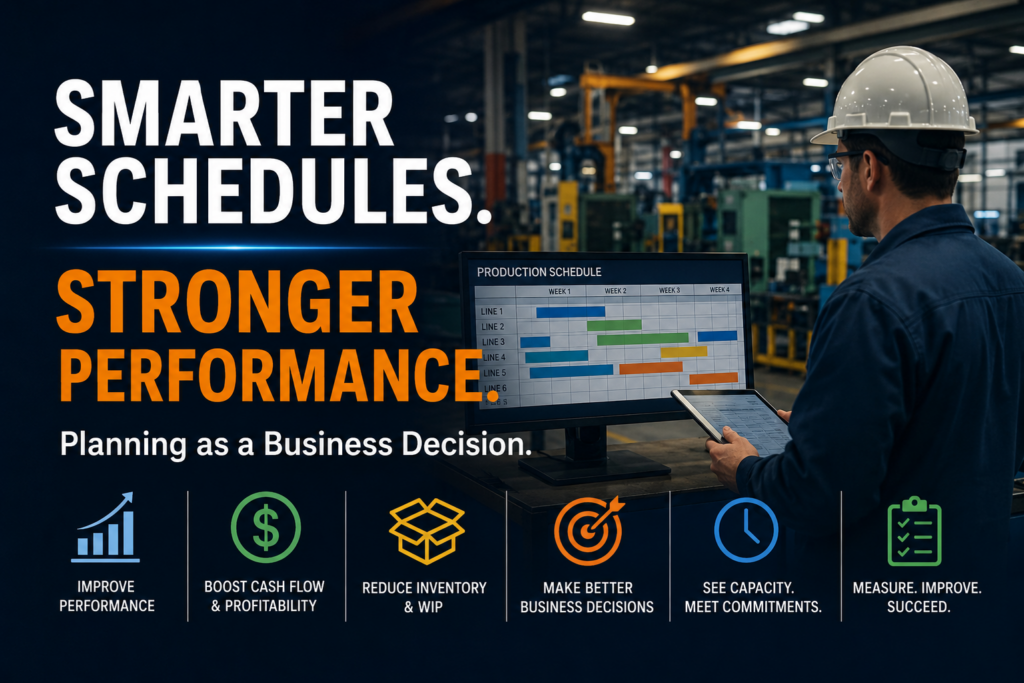
OpExChange welcomed Fred Gertz, Founder and CEO of Collide Technology, for a webinar exploring a challenge that affects manufacturers of virtually every size: the ability to effectively plan and schedule production.
But Fred’s message went well beyond building a better production schedule.
Throughout the session, he challenged participants to think about planning as a business decision – one that directly affects capacity, quoting, lead times, hiring, capital investments, cash flow and, ultimately, profitability.
Fred pointed to several familiar symptoms of poor planning: constantly expediting hot jobs, chronic firefighting, difficulty quoting reliable lead times, excess work-in-process, uncertainty about capacity and good employees becoming frustrated by an operation that is continually reacting to problems.
Finding the Real Constraint
A major theme of the webinar was the importance of understanding the true constraint within an operation.
That constraint isn’t necessarily a machine. It could be a skilled employee, inspection, an approval, a fixture or a process such as painting or curing. One of the simplest ways to begin identifying it is to look at where work consistently piles up, where overtime occurs, what resources employees are continually expediting around, and where downstream processes are waiting.
Once that constraint is understood, manufacturers can begin asking a much more valuable question: What is this constraint costing the business?
Fred encouraged manufacturers to connect operational measurements to financial performance. Rather than looking only at traditional metrics such as OEE or on-time delivery, manufacturers can also examine measures such as dollars generated per constraint hour and the impact that expediting, overtime, excess WIP and lost capacity have on realized margin.
Start Simple
While sophisticated planning and optimization can eventually involve advanced software, Fred emphasized that manufacturers don’t have to begin there.
His advice was practical: find a constraint, bring the people involved together for a short daily discussion, and start measuring.
Manufacturers can begin tracking metrics such as flow efficiency, expedite rate, constraint utilization and schedule adherence. One particularly simple starting point is to create a plan and then measure how frequently that plan has to change.
From there, the goal is to better understand how individual operational decisions affect the overall business.
As Fred summarized near the end of the session, manufacturers should strive to understand both how the different parts of the factory affect one another and how much those interactions cost the business. With that visibility comes the ability to quote more confidently, improve lead-time performance, make better capacity decisions and create more flexibility when conditions inevitably change.
Where Does AI Fit?
During the Q&A, the conversation turned to the role of artificial intelligence.
Fred explained that AI can help manufacturers work through the enormous amount of data and number of variables involved in a complex operation – helping narrow problems, make predictions, organize information and, in more advanced applications, support planning and scheduling decisions.
He also cautioned that technology isn’t a substitute for understanding the operation itself. Manufacturers can start today by identifying their constraints and understanding their processes before attempting to apply more sophisticated tools at scale.
That discussion provided a preview of what’s ahead for OpExChange. Fred will return in 2027 for a series of “Putting AI to Work in Manufacturing” workshops, beginning January 20 in Columbia, with additional workshops planned throughout the state.
Thank you to Fred and to everyone who joined us for an excellent discussion!