

October 5–8, 2026 | Bausch+Lomb – Greenville, South Carolina
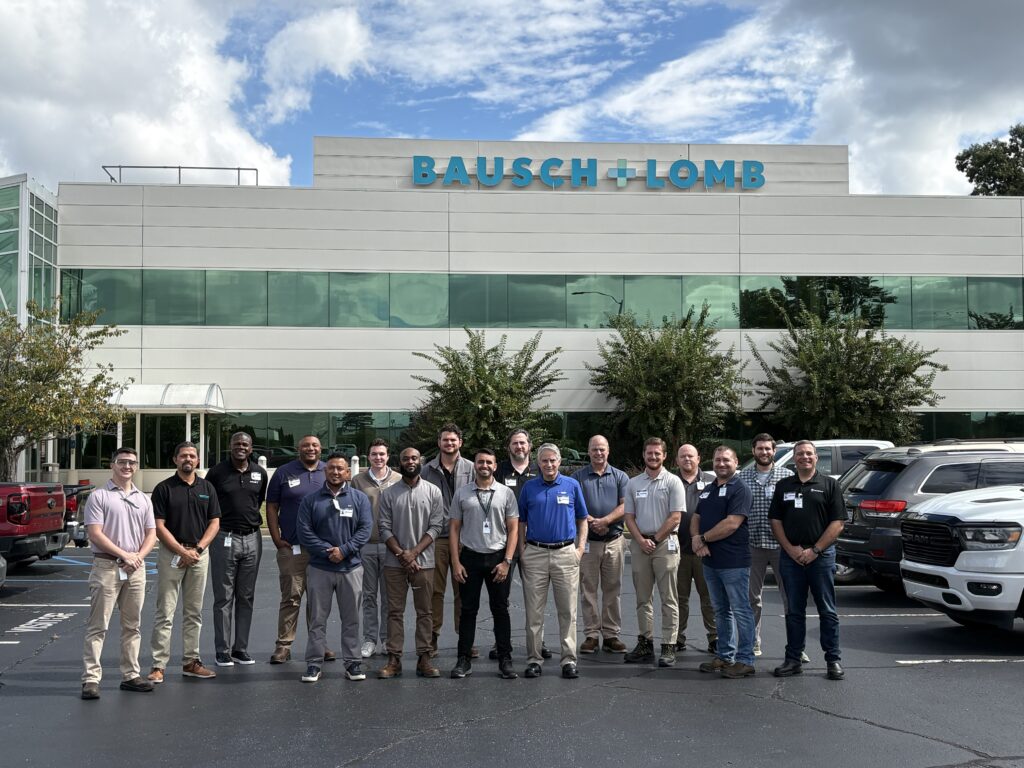
For four days, a group of manufacturing professionals from across South Carolina worked side by side with the Bausch + Lomb team in Greenville, analyzing equipment changeovers, challenging existing practices, and finding ways to eliminate waste. What made this event particularly special was how quickly individuals from different companies came together as one team.
The October 5–8 OpExChange SMED Kaizen brought 11 participants from nine member companies to Bausch + Lomb for an intensive, hands-on continuous improvement event. Their challenge was to reduce changeover times on the automated cartoner and case packer on Line 6, while also identifying opportunities to improve equipment reliability following each changeover.
Led by David Woods of Pro-Lean Systems, a Master Lean Six Sigma Black Belt and experienced lean manufacturing instructor, the event combined SMED training with practical application on the production floor.
By the end of the week, the team had delivered measurable reductions in changeover times, identified opportunities for even greater improvements, and demonstrated the value of manufacturers sharing their knowledge and experience to help one another succeed.
The Results – In Just Four Days
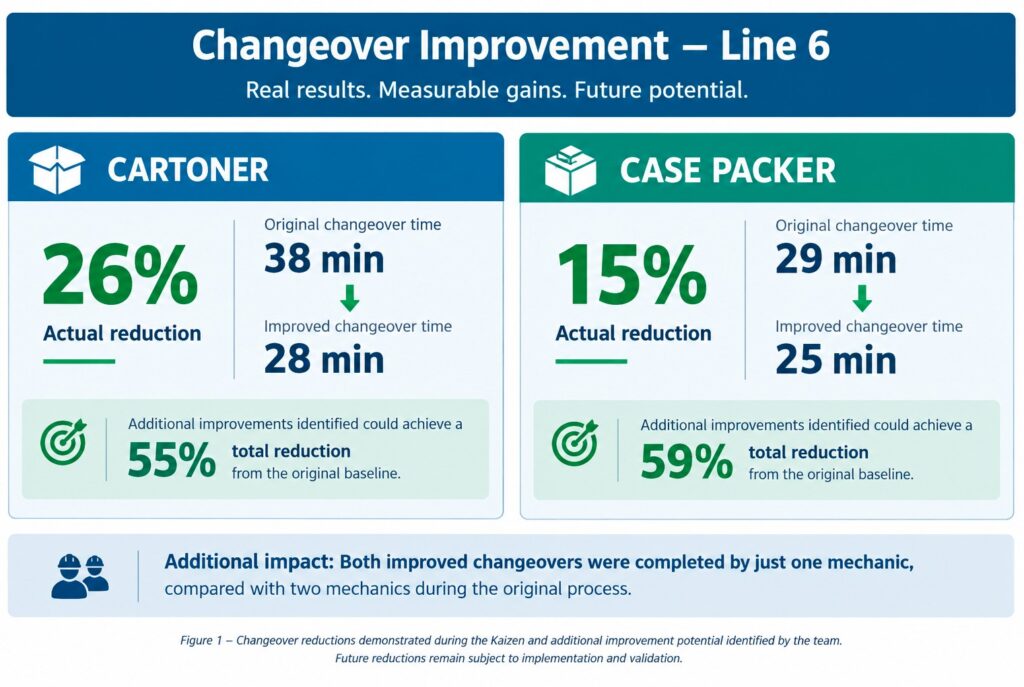
In just four days, the team delivered measurable improvements on both pieces of equipment. Changeover time on the cartoner dropped from 38 minutes to 28 minutes – a 26% reduction. The case packer improved from 29 minutes to 25 minutes – a 15% reduction.
Even more impressive, both improved changeovers were completed by just one mechanic, compared with two mechanics during the original process. This represented a substantial reduction in the labor required to perform the changeovers.
And the team wasn’t finished identifying opportunities. Additional improvements were documented that, once implemented and validated, could potentially reduce cartoner changeover time by 55% and case packer changeover time by 59% from their original baselines.
Even more impressive, both improved changeovers were performed by one mechanic rather than the two used in the original baseline, significantly reducing the total labor required.
These weren’t simply ideas generated in a conference room. The team developed and tested practical improvements, documented the results, and established a roadmap for additional reductions. The revised changeover times will be subject to further validation and standardization.
Learning SMED by Doing SMED
SMED – Single-Minute Exchange of Dies – is a proven lean methodology for reducing equipment setup and changeover times. Although originally developed for die changes, its principles apply to virtually any manufacturing operation requiring equipment changeovers.
David began the week by helping participants understand that reducing changeover time is about much more than gaining a few minutes of production capacity. Faster, more consistent changeovers can enable smaller production batches, lower inventory, greater scheduling flexibility, and improved customer responsiveness.
As David explained during the training:
“Setup reduction was never about setup time.”
His point was that the ultimate objective is not simply to change equipment faster. It is to perform changeovers consistently, eliminate unnecessary adjustments, and produce a good product the first time.
The team followed a structured process: documenting the existing changeovers, separating activities that required the equipment to be stopped from those that could be completed while running, streamlining essential tasks, and finding ways to eliminate unnecessary adjustments.
Much of the work involved carefully reviewing video recordings of the original changeovers, breaking them into individual activities, and questioning each step.
Why was a mechanic walking across the area to retrieve a tool? Could the necessary parts have been staged beforehand? Why did an adjustment require repeated trips to consult machine settings? Could a task be eliminated, simplified, or completed before the equipment stopped?
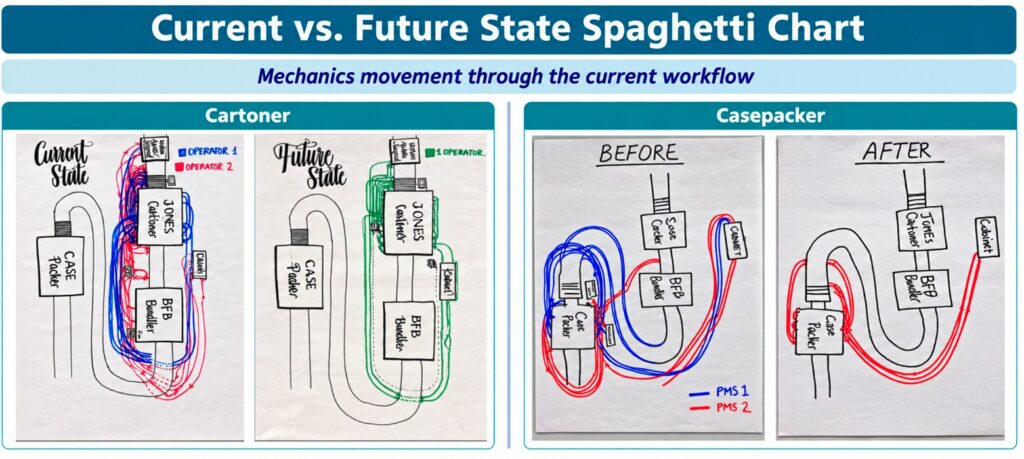
The group used spaghetti diagrams to visualize unnecessary movement, identified opportunities to better organize tools and change parts, and developed practical countermeasures to reduce wasted motion and time.
What initially looked like a routine changeover became a collection of improvement opportunities. The figure below shows the actual spaghetti charts with the before and after from the week.
Eleven Manufacturers – One Team
One of the most rewarding aspects of this Kaizen had little to do with the equipment itself.
Participants represented a remarkable cross-section of manufacturing industries and professional backgrounds – including medical devices, defense, automotive, packaging, plastics, nuclear energy, power transmission, and other industrial operations.
They brought different experiences, different ways of thinking, and different approaches to solving problems.
Yet within a remarkably short time, those differences became strengths.
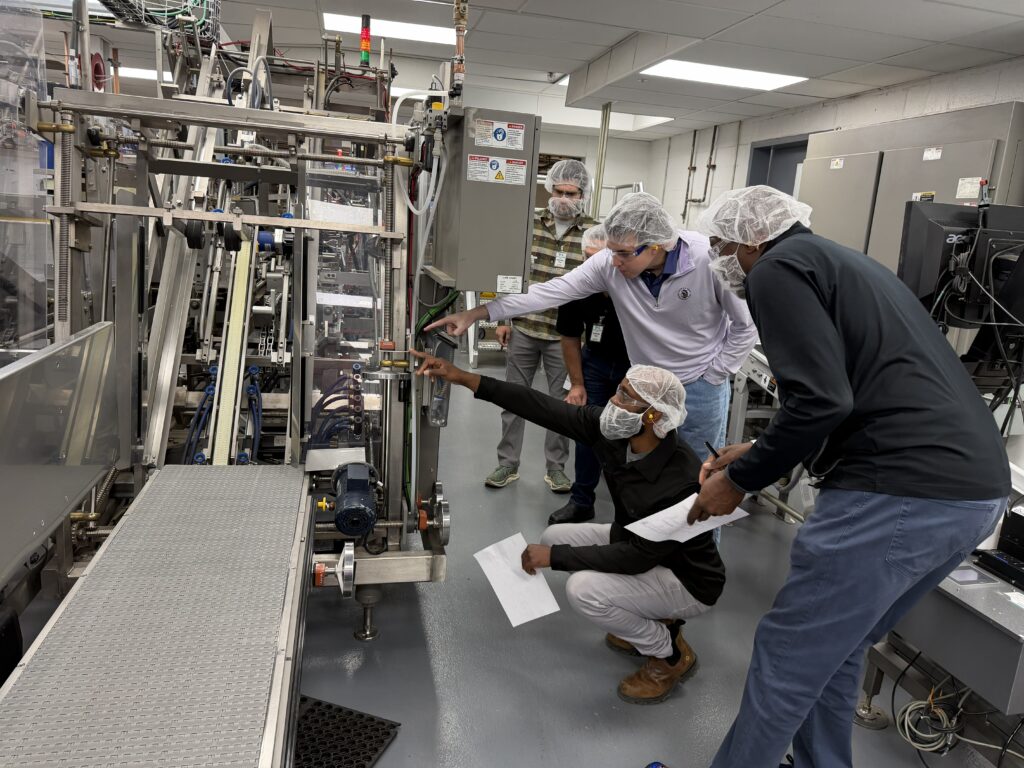
Watching this group work together was one of the highlights of the week. They were intensely engaged – studying video, debating possible improvements, challenging assumptions, sharing ideas, and collaborating directly with Bausch+Lomb’s mechanics, engineers, and production personnel.
There was no sense of visitors standing on the sidelines.
To an observer, it would have been difficult to distinguish the visiting OpExChange participants from Bausch+Lomb’s own employees. Everyone had taken ownership of the challenge.
David Woods made this same observation during the final presentation to Bausch+Lomb’s senior leadership:
“They were eager to be involved and cared about it and spent the time thinking through and asking questions.”
David went on to observe that the visiting participants seemed to own the process just as much as the host team.
That level of engagement was remarkable. These weren’t employees assigned to improve their own production line. They were professionals from other manufacturers who had invested four days to learn, contribute, and help a fellow OpExChange member succeed.
That is exactly what makes this type of OpExChange event so valuable. Participants aren’t simply learning from an instructor. They’re learning from one another while contributing their expertise to a fellow manufacturer’s operation.
Improving Within an FDA-Regulated Environment
As an FDA-regulated manufacturer, Bausch+Lomb operates under stringent quality and process requirements.
This introduced an important dimension to the Kaizen. Not every improvement identified by the team could be implemented immediately. Some equipment or process modifications would require formal review and validation before being introduced into production.
Rather than allowing these requirements to limit progress, the group distinguished between improvements that could be implemented immediately and those requiring additional engineering, evaluation, or validation.
Several improvements were put into practice during the event, contributing to the measured reductions in changeover time.
Others were documented as future opportunities, with the potential to reduce cartoner changeovers to approximately 17 minutes and case packer changeovers to approximately 12 minutes.
During the final presentation, Rob Pingry, Continuous Improvement Manager at Dodge Industrial, made an observation that captured an important lesson from the week:
“I’m always amazed going through lean projects that the simplest solutions are usually the best ones.”
Rob went on to point out that several of the improvements implemented during the event cost virtually nothing.
It was a great reminder that continuous improvement doesn’t always require major capital investments or equipment modifications. Sometimes the most meaningful gains come from better preparation, clearer procedures, improved organization, and eliminating activities that add no value.
More Than Faster Changeovers
An important objective of the Kaizen went beyond reducing the time required to change from one product to another.
Bausch+Lomb’s team explained that equipment sometimes required continued adjustments for one to three days following a changeover. The goal was to improve not only setup speed, but also the consistency and reliability of the equipment once production resumed.
The team identified opportunities involving better staging of change parts, point-of-use tools, easier access to machine settings, standardized hardware, and simpler component installation.
The next steps include validating additional improvements, standardizing revised changeover procedures, and monitoring equipment performance after changeovers.
These improvements could ultimately contribute to better overall equipment effectiveness (OEE), more predictable production, and less time spent troubleshooting after a changeover.
Taking the Results to Senior Leadership
On Thursday afternoon, the team presented its findings to Bausch+Lomb’s senior leadership.
The presentation included the original changeover analysis, spaghetti diagrams showing unnecessary movement, improvements already tested, and additional opportunities requiring follow-up.
The leadership response was extremely positive.
The results demonstrated not only what could be accomplished on Line 6, but also the potential for applying the same methodology throughout the Greenville operation.
Bausch+Lomb leadership expressed enthusiasm for expanding the SMED approach to other areas of the plant.
That may ultimately be the most significant outcome of the week – a successful pilot that could become the foundation for broader operational improvements.
A Collaborative Effort Worth Recognizing
The success of this Kaizen was made possible by an outstanding group of manufacturing professionals representing Arthrex, BAE Systems, Autokiniton, IPS Packaging, Wilbert Plastics, Westinghouse Electric, Dodge Industrial, CUI Heat, and Cytiva.
These 11 participants brought different experiences and perspectives, but shared a common commitment to learning, collaboration, and continuous improvement. Their enthusiasm, engagement, and willingness to roll up their sleeves made this a truly exceptional event.
A special thank-you to David Woods of Pro-Lean Systems for his excellent instruction and guidance throughout the week.
We are especially grateful to Bausch + Lomb for opening its doors and providing such a meaningful, real-world learning opportunity. Their entire team was incredibly welcoming, open to new ideas, and fully engaged throughout the week. Their willingness to share their challenges and work side by side with our participants was instrumental in making this Kaizen such a success.
The results were impressive, but the collaboration that made them possible was even more memorable.
This Is What OpExChange Is All About
The real power of OpExChange comes from manufacturers helping manufacturers.
This Kaizen was a perfect example.
Eleven professionals arrived from different companies, with different experiences and different perspectives. Four days later, they had become a highly engaged improvement team, delivered measurable results for their host, and gained practical experience they could take back to their own operations.
Perhaps nobody captured the spirit of the week better than Robert Stafford, Engineering Manager at IPS Packaging, during the final presentation:
“From the moment we stepped in, we weren’t outsiders. We were a part of the team.”
Robert went on to describe how welcoming the Bausch+Lomb employees had been, how openly they received suggestions, and how quickly everyone began sharing ideas without defensiveness or ego.
That openness was fundamental to the success of the Kaizen.
Bausch+Lomb gained fresh perspectives and meaningful improvements. Participants gained hands-on SMED experience, new ideas, and valuable relationships with peers from across South Carolina manufacturing.
And everyone left with a reminder that some of the best improvement opportunities emerge when people are willing to share their knowledge, challenge assumptions, and work together.
Four days. Nine visiting companies. One collaborative team. Real results.
That’s the power of the OpExChange.
About Bausch+Lomb
We’re a leading global eye health organization that is dedicated to protecting and enhancing the gift of sight for millions of people around the world – from the moment of birth through every phase of life. Our comprehensive portfolio of more than 400 products includes contact lenses, lens care products, eye care products, ophthalmic pharmaceuticals, over-the-counter products and ophthalmic surgical devices and instruments. Founded in 1853, we have a significant global research and development, manufacturing, and commercial footprint with more than 12,000 employees and a presence in nearly 100 countries. https://www.bausch.com/
About OpExChange
The OpExChange, an SCMEP program, is a peer-to-peer network of manufacturers and distributors in South Carolina known for generating success for members through benchmarking and best practice sharing. Member companies host events and share practical examples of industrial automation, lean manufacturing improvements, and leadership development. It is an invaluable resource to South Carolina companies that provide access to others who are on similar improvement journeys. If your company is interested in participating in this collaborative effort to improve both the competitiveness of your operation and South Carolina, contact Mike Demos (mdemos@scmep.org). More information and upcoming plant visits are available on the OpExChange website www.OpExChange.com.