

By Mike Demos, OpExChange Coordinator for the SCMEP
We held a plant visit last week at Metromont’s Greenville operation – one of those visits where the scale immediately grabs your attention.
Metromont is a Gold-level OpExChange member, with over twenty years in the network. Their Greenville site spans 63 acres, producing massive structural components that will eventually become parking decks, schools, data centers, and multi-story buildings across the Southeast.
The visit was led by Brandon Rogers, Continuous Improvement Engineer, who guided the group through both the presentation and the shop floor. Joining him was Payne Thomas, Vice President and General Manager of the Carolinas facilities, who stayed engaged throughout the entire visit and discussion.
At first glance, the operation feels very different from the manufacturing environments most of our members operate in. The size of the product, the outdoor setting, and the connection to construction all create a unique backdrop.
But as the visit unfolded, a different realization set in.
Despite the scale and the differences in product, the fundamentals were exactly the same.
This is still manufacturing. Metromont is navigating the same challenges that every OpExChange member faces – balancing people, process, and technology. They are managing flow, working around constraints, addressing bottlenecks, and ensuring quality. The context may be different, but the thinking is very much the same.
And that’s what made this visit so valuable.
Same Challenges, Just at a Different Scale
As Brandon walked through the process, he broke it down in a way that felt familiar to all the manufacturers in the room.
“We do more than just pour concrete here,” he explained, outlining how the work begins in the carpentry and steel shops before ever reaching production.
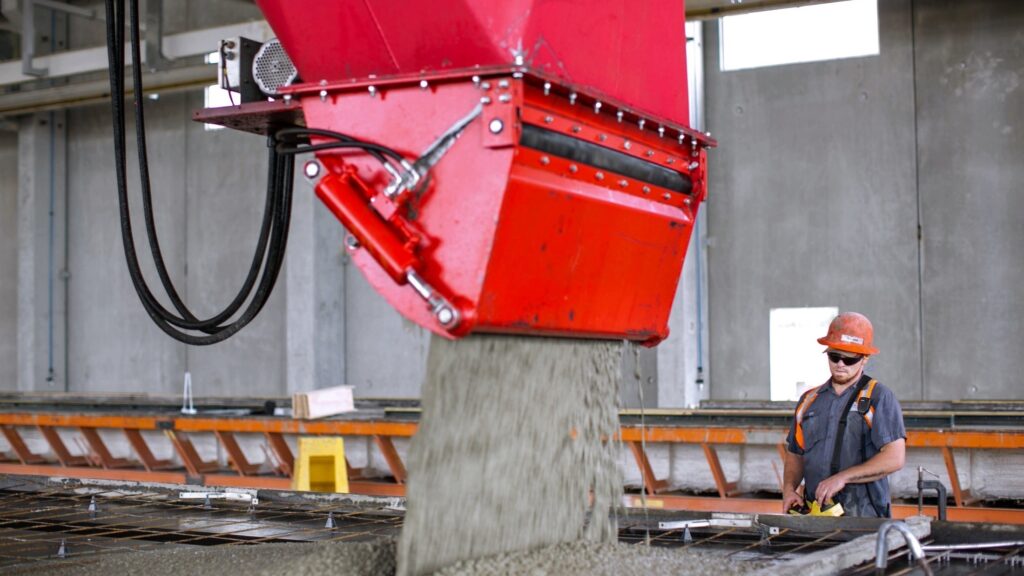
Forms are built. Reinforcement is fabricated. Then everything moves to the casting beds – the heart of the operation – where each component is built to exact specifications.
From there, the process flows in a structured sequence:
- Form building
- Reinforcement placement
- Concrete pour
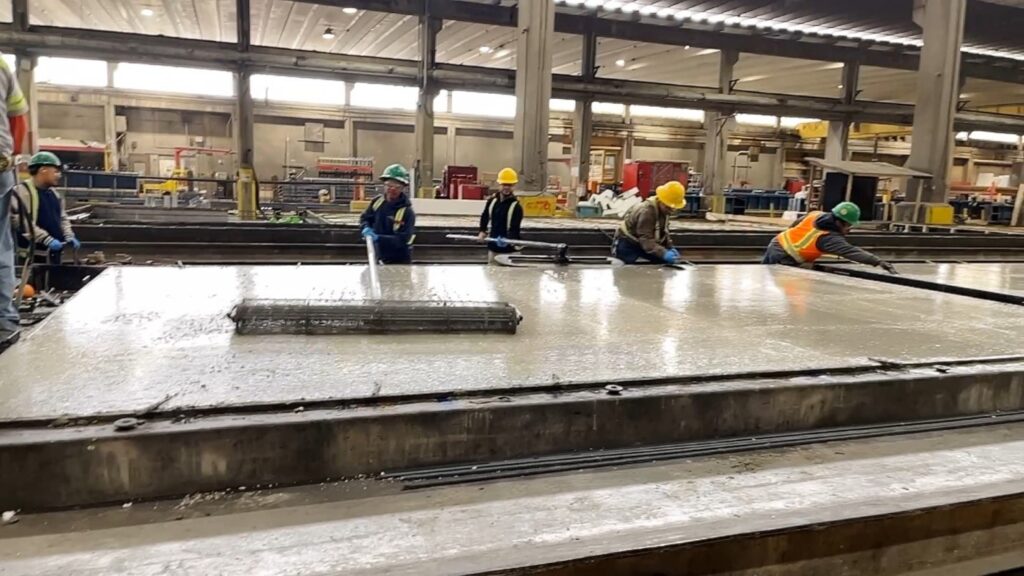
- Finishing
- Curing
- Stripping and staging
It’s a disciplined process. Repeatable. Controlled.
But as both Brandon and Payne both emphasized during the discussion, each piece is ultimately built for a specific project.
As Payne explained when asked about standardization:
“Each piece for each job is specific to that part… I can’t take a piece from one job and put it on another.”
It’s a reality many manufacturers face – standard processes applied to highly customized outputs.
Understanding the Constraint
Every manufacturing operation has a constraint, and at Metromont, it’s easy to identify.
The casting beds drive everything.
These beds are where the product is formed, poured, and cured. Once in use, the beds remain occupied until the product reaches sufficient strength to be removed. That creates a natural bottleneck.
While Brandon walked us through the process, he pointed out how much coordination goes into keeping those beds moving – especially with variables like curing time, weather conditions, and product complexity all in play.
It’s a familiar challenge – maximizing the utilization of a constrained resource while maintaining quality and meeting demand.
Different environment. Same thinking.
People: Craftsmanship Meets Manufacturing
What really brings the operation together is the people.
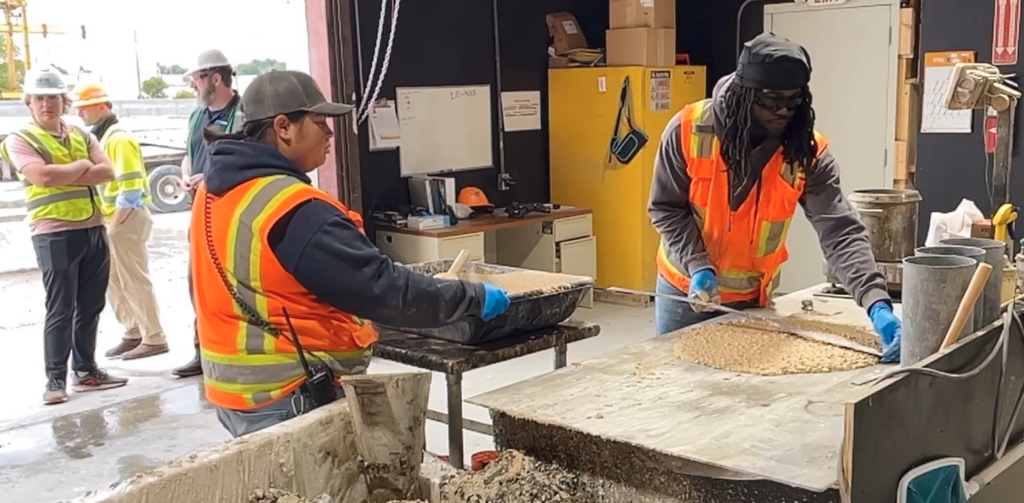
This is not a push-button process. It requires skilled trades across multiple disciplines – carpenters, welders, finishers – all working together to execute a highly coordinated process.
Metromont’s purpose is to “be a caring family that delivers excellence,” supported by values of faith, honor, and passion. During the visit, Payne Thomas was asked where those values originated. His response was simple – they come from the owners. As a third-generation, family-rooted company, that influence is still very much present in how the organization operates today.
And during the visit, that culture came through.
There’s a level of ownership in the work. These are not just parts – they are structural components that will become part of buildings used every day. That creates a different level of pride.
It’s a strong reminder that regardless of the product, manufacturing is still a people-driven operation.
Technology Supporting the Process
While the foundation is built on people and process, technology is clearly playing an increasing role – and Metromont provided a strong example of how Industry 4.0 can be applied in a very practical way.
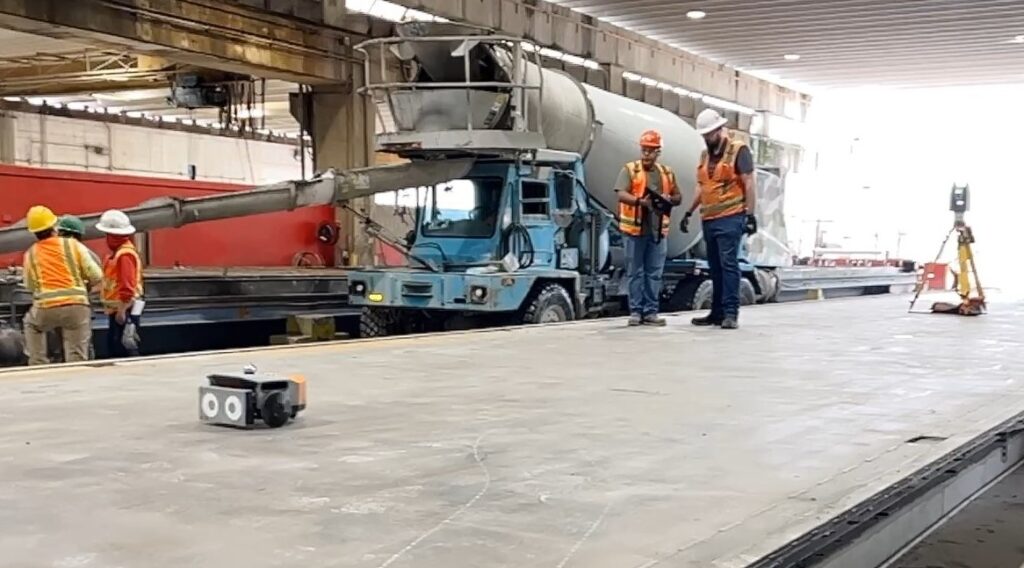
One of the more interesting examples discussed during the Plus/Delta session was their use of robotics – specifically a system they refer to as “Dusty,” developed by Dusty Robotics.
At first glance, it’s a relatively small robot operating in a very large environment. But the impact it’s having is anything but small.
The team shared that this implementation is:
- Delivering over seven figures in annual savings
- Driving approximately a 20% improvement in labor utilization
- Increasing overall capacity significantly
- Reducing cycle time in critical steps of the process
- And dramatically improving ergonomics and safety by removing physically demanding layout work from the workforce
As Payne Thomas put it:
“We wouldn’t be able to pour half the yardage we pour today if it wasn’t for that robot.”
What makes this example stand out is not just the technology itself, but how it’s being applied.
This isn’t technology for the sake of technology. It’s targeted. It’s solving a specific problem and delivering measurable results across multiple dimensions – cost, capacity, safety, and speed.
It’s also a great example of Industry 4.0 in action within a heavy manufacturing environment. Rather than replacing the core process, the technology is enhancing it – allowing the team to execute the same process more efficiently, more safely, and at a higher level of performance.
Technology and Fundamentals – Not Either/Or
While the use of advanced technology like robotics stood out, what was equally impressive was the continued focus on lean fundamentals.
Throughout the presentation and the tour, Brandon Rogers shared several examples of improvement work being driven not by new technology, but by structured problem solving. In particular, he walked through multiple examples using an A3 approach – clearly defining the problem, understanding the current state, and implementing practical, targeted countermeasures.
These weren’t theoretical exercises.
They were real improvements that simplified the work for operators, reduced complexity in the process, and delivered measurable results.
In one example, Brandon described a project that didn’t involve automation or significant capital investment, but instead focused on improving how the work was done. The result was a more efficient process, reduced burden on the workforce, and tangible cost savings.
Not seven figures – but meaningful right to the bottom-line.
And just as important, it made the job easier for the people doing the work.
That’s an important distinction.
It would be easy to walk away from a visit like this focused only on the technology – the robot, the automation, the scale. But what stood out just as much was the discipline around continuous improvement.
The team isn’t relying on technology to solve every problem.
They are applying lean thinking first – understanding the process, identifying waste, and improving flow. Then, where it makes sense, they layer in technology to amplify those gains.
It’s not either/or. It’s both.
And that combination – strong fundamentals supported by the right technology – is what drives sustainable improvement.
Process Integration: More Than Just Production
Another theme that came across clearly is how much of the overall value stream Metromont controls.
As Brandon explained:
“We do more than just pour concrete… from design, budgeting, layout, engineering, production – and even delivery and erection.”
That level of integration creates both complexity and opportunity.
It requires coordination across multiple functions, but it also allows for tighter alignment between what is designed, what is produced, and what is needed in the field.
It also enables parallel execution – manufacturing the building while site work is happening – reducing overall lead time and improving project flow.
Again, a familiar concept in a different context.
Final Thoughts: More Alike Than Different
As the tour wrapped up, the group gathered for the customary Plus/Delta session – always one of the most valuable parts of an OpExChange visit. The Metromont team shared openly, and just as quickly, others in the room began offering ideas, perspectives, and similar experiences from their own operations.
Different industries. Different products. But the same challenges.
What stood out was how easily the conversation flowed – because everyone could relate. Whether discussing robotics, process flow, or workforce considerations, there was a common understanding.
That’s what makes these visits so valuable.
It’s not just about seeing a new operation – it’s about recognizing how much we have in common, and learning from each other.
And that’s what makes the OpExChange work.
About Metromont
Founded in 1925 and headquartered in Greenville, South Carolina, Metromont is one of the leading precast and prestressed concrete manufacturers in the United States. The company produces structural and architectural concrete components used in a wide range of applications, including commercial buildings, data centers, educational facilities, healthcare, and infrastructure projects.
Metromont offers a comprehensive approach that includes design, engineering, manufacturing, delivery, and installation, helping customers bring complex building projects to life with efficiency and precision.
With operations across the Southeast and a legacy spanning more than a century, Metromont continues to combine industry expertise, innovation, and a commitment to quality in serving its customers and communities.
About OpExChange
The OpExChange, sponsored by the South Carolina Manufacturing Extension Partnership, is a peer-to-peer network of manufacturers and distributors in South Carolina known for generating success for members through benchmarking and best practice sharing. Member companies host events and share practical examples of industrial automation, lean manufacturing improvements, and leadership development. It is an invaluable resource to South Carolina companies that provide access to others who are on similar improvement journeys. If your company is interested in participating in this collaborative effort to improve both the competitiveness of your operation and South Carolina, contact Mike Demos (MDemos@scmep.org). More information and upcoming plant visits are available on the OpExChange website www.OpExChange.com.
Frequently Asked Questions (FAQ)
What does Metromont manufacture?
Metromont produces precast and prestressed concrete components used in buildings such as parking decks, schools, data centers, and commercial structures.
What is precast concrete manufacturing?
Precast concrete manufacturing involves producing concrete components in a controlled environment, then transporting them to construction sites for assembly.
What is the main constraint in precast manufacturing?
At Metromont, the primary constraint is the casting beds, where concrete is poured and cured. These beds must be carefully managed to maintain production flow.
How is robotics used in precast concrete manufacturing?
Metromont uses robotics, including layout automation from Dusty Robotics, to improve accuracy, reduce labor strain, increase capacity, and enhance safety.
How does lean manufacturing apply to construction-related manufacturing?
Lean principles such as flow optimization, waste reduction, and constraint management apply directly, even in highly customized environments like precast concrete.
What makes Metromont’s operation unique?
Its combination of large-scale production, high customization, full value-stream integration, and the balance of craftsmanship with advanced technology.